Sunday, 14 April 2013

UK ALBUM SALES INCREASE IN 2013


I know we're supposed to be lamenting the gradual loss of the music industry "as we know it", but despite the massive state of flux in which it finds itself, it has seen some real growth in the first three months of this year. 

The BPI, the trade body of the British Recorded Music Industry, have released a set of very revealing figures which show that combined CD and digital album sales were up 1.4% in the three months to the end of March. That might not sound like very much, but the trend had been stuttering since 2010 and, of course, we've also endured some pretty grim weather so far in 2013 which hasn't made it any easier out on the High Street. Digging into the figures, it's even more positive as it's the first quarter's growth since the last quarter of 2009. I suspect some of the growth came from massive discounting at HMV before it was rescued, but nevertheless, it's another sign that the music-buying public might be returning to their former habits.

In my last piece (available here), I highlighted three trends which might help give the industry a nudge in the right direction - the saving of HMV, the growth of crowd-funding phenomena such as Kickstarter and the annual music fest that is Record Store Day. Is there a link between these and the growth in sales? I think we need to leave it another quarter at least before we draw any firm conclusions, but my gut feel is that, well, they can't have done any harm, can they?

Let's take a more detailed look at the BPI figures.


Album Sales Hit 23.3 Million


Compared to the same period last year, an extra 300,000 albums have been sold in the first quarter. In the increasingly digital world, that's no mean feat since consumers have shown an increasing preference for individual songs and singles - a trend which has seen singles sales (often boosted by back catalogue content) become very healthy indeed. Beneath that figure, CD sales continue to decline and digital albums increase, the latter format accounting for 9 million (38.6%). A positive sign for audiophiles was the continuing growth of vinyl LPs, the growth (albeit from a low base) was an incredible 78.1% - the third quarter of growth and one which underlines that bands and record labels are increasingly getting their sales strategies right.

David Bowie
Surprise return in February with his first new album
in some ten years - in went straight to number one

despite no formal publicity, interviews or
 appearances. Just the power of dropping a
video onto You Tube and sitting back.


The overall sales growth has also been helped by a combination of striking new artists emerging (such as Emeli Sande, Jake Bugg and Mumford & Sons), the enduring popularity of the "Now" series of compilations (the 84th having just been released) and the sudden and welcome rebirth of David Bowie and his new album, The Next Day. Another key aspect of the numbers is the relative health of indie bands and labels with their releases and growing confidence in the still uncertain economic climate. Acts such as Nick Cave & The Bad Seeds, Biffy Clyro, Bastille, The Stereophonics and Atoms For Peace all sold well and helped the "indies" to secure more than 11% of total sales. Pleasingly, veteran artist Richard Thompson with his new album Electric saw a return to the mainstream charts and is so far well within the Top 20 selling indie artists of the year.


Table 1 - Top 20 Best-Selling Albums - Q1, 2013
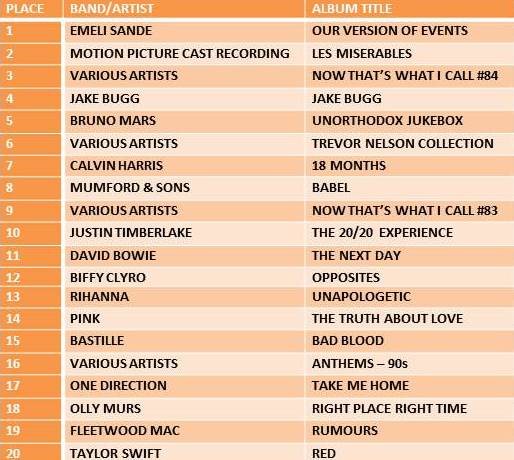


Table 2 - Top 20 Best-Selling Indie Albums - Q1, 2013 


Singles Sales Continue Upward Trends


There's a view that the weekly music charts on Radio 1 no longer have the cachet or influence that they once did.

The received wisdom is that nobody buys singles anymore, we no longer all gather around the radio on a Sunday to listen to the run-down and that since the demise of TV's Top of The Pops, everything's so much more fragmented these days.

Macklemore & Ryan Lewis
Half a million sales for Thrift Shop
It is true that the race to achieve a big-selling number one hit is somewhat devalued other than during the run-in to Christmas. It takes fewer sales than of yore to get into the charts or the top twenty and thus, the number one slot - but despite this, sales continue to grow. The first quarter this year saw 48.5 million singles sold, nearly one for every member of the population of England and a 3.9% increase on the same period in 2012 and continuing a growth trend started some while ago. How does this equate with the lower sales per single to get in the charts? The truth is that there are more singles available than before (as noted before, digital back catalogues have become very popular) and purchases have become much more diverse. Even so, the biggest selling single so far this year has sold a massive 510,000 -  rappers Macklemore and Ryan Lewis seem to have got the touch as far as the single-buying public is concerned.

Another trend which is having an impact is the increasing ease by which bands can get their music produced and published: there's an immediacy with releasing songs that didn't exist in a purely vinyl or CD era. Artists no longer have to wait to create a killer album, they're taking more and more advantage of the EP format, four or five songs to test the water and grow their base. Whilst EPs probably barely scratch the surface in terms of total UK sales, they play an important role in maintaining band name awareness - so critical for the music press and buyers alike.

Where Next?


Indie darling Laura Marling - her much anticipated
fourth album "Once I Was An Eagle" is due for
release on May 27th. Big sales are expected. 
There are a number of key album releases lined up for the current quarter, ranging from indie folk songstress Laura Marling through Michael Buble to the re-invented Rod Stewart. With HMV saved and a High Street presence secured, with Record Store Day looming this coming Saturday (April 20th) and general UK retail sales showing some small signs of recovery, I'd bet that the album growth trend will continue.

In a world where we all have our likes and dislikes, the bands and artists who we love and enjoy and those we despise, does any of this talk of *growth* really matter? I think it does. It breeds a confidence which feeds through to musicians, whether they are experienced acts or just those barely starting out. With that confidence, there's a chance for them to make some music - and a good chance that we'll get to listen to it.

And that is to be applauded.

Alan Dorey  


Friday, 5 April 2013

A LITTLE RAY OF SUNSHINE


It's been a rather dispiriting few months in the music industry with the continued decline in physical music sales and the troubles affecting HMV. 

Added to this has been the news that 2012 saw a slowing in the growth of digital sales, which although still on an upward trend, are no longer sufficient to plug the gap left by the fall away of CD purchases.

There's still plenty of good music around with bands and artists doing all they can to get their musical endeavours out in front of the public - but there's no doubt they have to be smarter and work much harder to earn a decent income. 

So, why am I a little optimistic?

A number of factors are coming together which might enable some sort of stability in the music business, a stability which would be most welcome by creators and consumers alike. I'm not suggesting that there is a problem-solving panacea just around the corner, but I do believe that there are some real opportunities to be seized. 

Let's take a look at them.

HMV SAVED


I've written previously about the long, slow and agonising death throes of HMV (most recently right here:  HMV Store Closures Announced )

An all-too-common site at HMV
stores in the past two months
I'd tried to be positive about the future of the remaining HMV estate and couldn't believe that the music industry would want it to go to the wall and close off volume CD sales. I was pleased to see that Hilco, a "distressed business restructuring specialist" was in the frame for acquiring the business, but uncertain as to what they would actually do if successful. Over 80 HMV stores had already been closed by the administrator and whatever behind-the-scenes power-brokering was going on, it was clear that the news vacuum wasn't helping.

Today, Hilco have confirmed their purchase of the remaining 141 stores (25 of which had already been confirmed for closure), saving 2500 jobs in the process and thus paving the way for some sort of continued High Street musical presence around the UK. They already own HMV Canada and have turned that round, closing large out of town sites (expensive to operate) and majored on smaller more music-focussed stores. They note that the UK market is more difficult, but have expressed confidence that they can put the business back on to the road to recovery. Already, they've ditched the sale of mobile phones, tablets and other such accessories in a bid to get closer to the raison d'etre of the stores: selling music and movies. Hilco's Chief Executive Paul McGowan says that "HMV Canada is now trading strongly and....we believe that (the UK) has a succsseful future ahead". 

Two key things Hilco have said give me some cause for hope: they're retaining the FOPP sub-brand (nine stores which might provide a template for increased music sales) and have confirmed that they'll be increasing the range of music offerings. Admittedly, there had been  retrenchment in the past couple of years with many of HMV's specialist genre sections disappearing or being minimised into a handful of populist titles, but to see an acknowledgement that they must have the range and variety is good to hear.

With a fair wind, the Hilco
acquisition of HMV will be a Good Thing
I'm not suggesting that HMV is the lifeblood of the UK music retail industry, but it is a key component and has a critical mass which is more distinct and less amorphous than that of the independent music stores. Critical mass means that it can punch above its weight and give record companies and distributors some certainty about sales volumes. This is even more important when on-line retailers such as play.com are now struggling in the face of the removal of VAT-free treatment and they're having to compete harder with the rest of the UK.

And, whilst many people do like to buy their musical wares as digital downloads, there are still many customers around the UK who want the experience of browsing in a real store and the chance to buy a tangible product. HMV will underpin that desire and I hope that its forthcoming revitalisation works.

These are the HMV and FOPP stores that will now remain open:

Aberdeen, Ayr, Banbury, Bangor, Basildon, Basingstoke, Bath, Belfast Donegall Arcade, Birmingham Bullring, Blackpool, Bluewater, Bournemouth, Bradford, Brighton Churchill, Bristol Broadmead, Bristol Cribbs, Bromley, Bury, Bury St Edmunds, Cambridge, Canary Wharf, Canterbury, Cardiff, Carlisle, Chelmsford, Cheltenham, Chester, Chichester, Colchester, Coventry, Crawley, Cwmbran, Darlington, Derby, Doncaster, Dundee, East Kilbride, Eastbourne, Edinburgh Fort Retail, Edinburgh Ocean Terminal, Edinburgh Princes Street, Exeter, Bristol (Fopp), Cambridge (Fopp), Covent Garden (Fopp), Edinburgh (Fopp), Glasgow Byres Road (Fopp), Glasgow Union Street (Fopp), Gower Street London (Fopp), Manchester (Fopp), Nottingham (Fopp), Gateshead, Glasgow Argyle, Glasgow Buchanan, Glasgow Fort, Gloucester, Grimsby, Guernsey, Guildford, Hanley, Harlow, Harrogate, Hastings, Hatfield, Hereford, High Wycombe, Horsham, Hull, Inverness, Ipswich, Isle of Man, Isle of Wight, Islington, Jersey, Kettering, Kings Lynn, Kingston, Leamington Spa, Leeds Headrow, Leeds White Rose, Leicester, Lincoln, Liverpool One, Livingston, Llandudno, Maidstone, Manchester 90 Market Street, Manchester Trafford, Mansfield, Merry Hill, Middlesbrough, Milton Keynes, Newcastle, Newport (Wales), Northampton, Norwich Gentlemans Walk, Norwich Chapelfield, Nottingham Victoria, Nuneaton, Oxford, Oxford Circus, Peterborough Queensgate, Plymouth Drake Circus, Poole, Portsmouth Commercial Road, Portsmouth Gun Wharf Quay, Preston, Reading Oracle, Romford, Selfridges Oxford Street, Sheffield High Street, Sheffield Meadowhall, Shrewsbury, Solihull, Southampton, Southend Victoria, Southport, Speke Park, Staines, Stevenage, Stirling, Stockport, Stratford upon Avon, Stratford City Westfield, Sunderland, Sutton, Swansea, Taunton, Thanet, Thurrock, Truro, Tunbridge Wells, Uxbridge, Westfield London, Wimbledon, Winchester, Wolverhampton, Worcester, Worthing, Yeovil, York.

RECORD STORE DAY


The second trend that can aid music sales is - of course - Record Store Day.

It's now an international phenomenon and sees the third Saturday in April each year become the focus of a massive campaign to sell a wide range of CDs and LPs, many in special limited editions. The next event comes up in just over a week's time on April 20th and it's already shaping up to be a huge event in the retailing calendar. The ethos is very much one of record stores, artists and music fans joining together to preserve and promote the sale and enjoyment of a wide range of musical genres.

It all started back in 2007 in the USA when a number of fans and promoters led by Chris Brown got together to try and reverse the continuing decline in physical music sales. Their efforts were rewarded when hundreds of stores around the US found willing support from local bands and musicians who donated work, made free guest appearances and in some cases, released specially recorded or rare back-catalogue music to help make the campaign come alive.

The following year saw the UK join in when a number of our most iconic independent record stores grabbed the opportunity, stores such as Spicers in Cardiff, Jumbo Records in Leeds and (my personal favourite) Piccadilly Records in Manchester. The scale and interest in the event took off and bigger name bands and artists got involved, record labels saw a mutual interest in supporting record stores and increasing sales and the public truly embraced it.

Special Offers on Record Store Day?
There's a fine balance between it being an altruistic event, designed to help the music business survive - and even thrive - and a hard-nosed business transaction where record companies and  bands see an opportunity for profit. For every special limited edition release that is genuinely wanted by fans, how many are there which are merely opportunistic money-grabs with little redeeming value? So far, the balance has held out - albeit with a bit of tugging and pulling going on. This year's event seems set to be the biggest yet and the promotion has now spread beyond the US and UK to much of Europe too. Record stores are pinning their hopes on a bonanza day, many of them doing some excellent promotion, involving the bands and keeping their customers informed of the offers, deals and special releases they'll have.

Indeed, so popular is the event that (once again) stores won't be able to get enough stock to satisfy demand for certain of the special releases - which although frustrating, I suppose is a positive in that it maintains the interest. As long as the independents continue the good work all year round (building on the Record Store Day buzz), they'll hold onto some of the extra customers and gradually build their base - thus enabling greater sales opportunities in the future.

Jack White - Record Store Day
Ambassador
And when it comes to pass that artists such as Bob Dylan (with a 9500 limited edition new single), David Bowie (with a white label limited edition track from his new album) and Pink Floyd (with a special limited release of See Emily Play in 7 inch vinyl) are supporting it, there may well be cause to be positive for the future.

Here's a listing of many of this year's offers, so now there's no excuse, get down to your local Record Store and Do your Bit:


KICKSTARTER


The final trend that is providing some solace to  bands and artists sits firmly in the realms of social media. It's part of what has become known as "crowd-funding", a process through which musicians can appeal directly to their fans for funds to enable them to record (for example) their next album. It's a trend that has exploded since it was first used in 2009 and whilst not a magic bullet, it has shown that it can be very effective indeed.

Kickstarter is a private-for-profit company founded in the US and they provide the infrastructure and on-line tools to artists to enable them to raise funds. Key to the process is that *investors* (usually fans) can't make a profit out of their involvement, but can receive special rewards such as exclusive limited editions or posters and T-Shirts and other items which may not cost much to produce, but are valued as "special" by the fan. Kickstarter doesn't just restrict itself to the music business - it's also been involved in fund-raising for stage shows, indie films and books and comics as well. Musicians need to approach it carefully - I can't see it really working for a band or act who don't already have some sort of following or local fan-base. They must have something that their fans want or desire, something they'll pay over the odds for in the hope that this odd sort of symbiotic relationship produces some fine new music. But work it does - and several acts have found that they've hit their fund-raising targets very quickly - all on-line and all facilitated by the Kickstarter ethos.

Kickstarter has grown in just four years to a business which has seen something approaching $400m pledged for over 75,000 projects, although there is a cautionary note that not all projects  get the green light. Kickstarter say that about 46% of initiatives raise the money that's needed, although that figure has gradually been increasing as the various parties become more used to how it works and what commitment they need to bring to it. There are a number of *name* artists who have made it work after failing to excite record labels, artists such as Tom Rush and Amanda Palmer, but I believe that the best and most exciting results are coming from emerging bands for whom the very notion of a record company taking them on board is but a pipe-dream.
Pipedream or Solution?
We mustn't always knock record companies and their labels. After all, many of them have less funding available to grow new music, are often part of large conglomerates for whom the bottom line is everything and are themselves uncertain about how they will survive. But, if new acts who have grown a local following can't see a label taking them on by offering them a recording advance, then Kickstarter could very well be an alternative route.

WHAT NEXT?


Three swallows does not a summer make, or whatever the musical equivalent is.

We are still deep in troubling economic times and there is little sign that we'll emerge from them just yet.

The underlying trends in the music business still grind onwards and are difficult to reverse.

However, the survival of a key chunk of the UK music selling business - HMV -  is a good sign. 

Combine that with the greater awareness of survivability from the independent stores (powered by Record Store Day) and the chance for bands to use Kickstarter to fund music production and we may have a chance.

The musical patient's illness need not be terminal and, given the right treatment, might make a reasonable recovery. 

I shall return to review the patient's case notes in the near future.

Alan Dorey


Thursday, 7 February 2013


7th February - HMV Store Closures Announced


Behind-the-scene negotiations continue to enable Hilco to take formal control of HMV, but the first visible signs of change have emerged today. The administrators - Deloittes  have announced the closure of 66 stores over the next two months. This follows a string of job losses at HMV's head office and brings the likely job-loss total to around 1100. Looking at the list of affected stores, it's clear that some of the larger out-of-town sites have been targeted as have stores in towns and cities with more than one outlet. The retail park sites are too large and expensive for the future model that will emerge (probably a move back to it core business of music and DVDs/blueray) even if they (currently) have a better and wider range of music available.

Edinburgh - Five HMV stores to close
Our nearest - Bournemouth Castlepoint - is to go, but just look at Edinburgh: five sites are set to close, so one assumes that there's at least one site remaining in the Scottish capital.

Here's the full list:

England

Ashton-under-Lyne, Barnsley, Bayswater, Bexleyheath, Birkenhead, Birmingham Fort, Blackburn, Boston, Bournemouth Castlepoint, Bracknell, Burton-upon-Trent, Camberley, Chesterfield, Croydon Centrale, Durham, Fulham, Huddersfield, Leamington Spa, Leeds White Rose, Loughborough, Luton, Manchester 90, Moorgate, Orpington, Rochdale, Scunthorpe, South Shields, Speke Park, St Albans, St Helens, Stockton-on-Tees, Tamworth, Teesside, Telford, Trocadero, Wakefield, Walsall, Walton-on-Thames, Wandsworth, Warrington, Watford, Wellingborough, Wigan, Wood Green, Workington

Scotland

Dumfries, Edinburgh Fort, Edinburgh Gyle Centre, Edinburgh Ocean, Edinburgh Princes Street, Edinburgh St James, Falkirk, Glasgow - Fort, Glasgow - Silverburn, Glasgow Braehead, Kirkcaldy

Northern Ireland

Ballymena, Belfast Boucher Road, Belfast Forestside, Coleraine, Craigavon, Derry, Lisburn, Newry, Newtownabbey

Wales

Wrexham

What Next?

There's no word yet on the nine-store sub-brand Fopp, outlets which have a more focused approach to music and movies as well as a better understanding of their record-buying customers. I'd expect further closures in the next six months, but it does all depend upon the outcome of discussions with record distributors (the extent of credit lines made available) and landlords (the degree to which they will be flexible in granting rent reductions or holidays).


As for the public, those who like to browse stores and buy physical releases, well - it looks like there's a reprieve for now.


Alan

7th February 2013  

Monday, 21 January 2013

HMV SOLUTION IMMINENT?

As many had hoped, it does look as if there's a gathering wave of good will towards HMV right now. My previous blog on 15th January outlined the reasons why HMV had found itself in administration and expressed the hope that a combination of the music industry and some White Knight financier would see it survive, somehow. What had been a couple of "straws in the wind" seem to be firming up and we need to check these out.   

Today, HMV's adminsistrators Deloittes have confirmed that after looking at the company's finances, the stores can now start honouring gift vouchers once more. HMV took a lot of flak from customers for the refusal to accept them, particularly as there were many more of them in circulation than usual following the festive season. But that in essence was part of the issue. The gift voucher money had already been paid to HMV and taken into account when they called in the administrators. Deloittes wouldn't accept a position whereby stock would flow out of the stores for which no further income would be received. Whether this is an acceptable or moral course of action is open to debate, but it has been the pattern with many other high street stores that have taken the administration route.

Interestingly enough, there doesn't seem to be any hint of HMV store disposals yet and the planned January "25% off sale" went ahead and still continues. 

Salvation?    

Record buyers with longer memories will recall that when both Borders and Zavvi closed their stores, one of the communities that suffered the most were the indie record labels. They relied on their wares featuring in-store and with distribution channels closed off, it set their financial alarm bells ringing too. It was almost a double blow for some of them - reduced distribution and stock tied up in the stores with little or no hope of financial redress.  

HMV poses an even bigger threat as it is the last national chain and had, until recently, an admirable policy of supporting genre music and small labels alongside the big international firms such as Sony. Ironically, several of them - such as The World Music Network - had seen increased sales and profits via HMV. But, there's a clear danger that with little or no distribution, many smaller labels will also cease trading. Behind the scenes, intense lobbying has been taking place to ensure that these factors were also taken into account in determining HMV's future. The knock-on effect would be felt beyond those labels as it would reduce the number of publishing outlets for aspiring bands - and although many can take a DIY approach, it's not as simple or *lucrative* as many might think.

The big groups themselves are also keen to keep HMV intact: despite their size, they too need distribution and they have rostas of bands and artists who have deep back catalogues which need to be promoted. They also have big interests in films and associated DVD sales and it's not at all surprising to see Warner Brothers, Universal and 20th Century Fox trying to protect those *assets* by supporting an appropriate outcome. 
  

HMV Vancouver
It now looks as if what is quaintly known as a "restructuring specialist" Hilco has emerged as a front-runner to buy HMV. It's a company that buys "distressed businesses" where they believe there's some hope of turning them round as a going concern. They have history in this area having bought HMV (Canada)  a couple of years ago for the paltry sum of £2m and already, some of the largest flagship stores such as that in Vancouver have been closed. They have, though, opened smaller, more specialist outlets in city suburbs and it'll be very interesting to see where this policy takes them in the longer term. Importantly for the UK, the major record and DVD companies seem to be uniting behind the Hilco bid - which (apparently) is one of some 50 expressions of interest shown in the chain. It also seems that record and DVD suppliers see Hilco as a positive option and may well be prepared to support them on any acquisition - and ensure that decent credit lines are provided, credit lines which are the life-blood in this sort of business. There are even hints that prices charged to HMV might be reduced.

Hilco have made no comment so far - and there are some conflicting reports about what the major record companies are actually doing (if anything) to resolve this crisis for HMV. 

Brand New Record Store in
Bournemouth, Dorset
Let's not forget, HMV may not be the best record stores around - there are still some very good independent record stores in the UK - but they do have a presence in 230 or so towns and cities around the UK. Of course it would be nice - in the event of HMV's finally collapsing - that more indies spring up. Some might, but the there will be huge challenges to overcome: firstly, the high cost of location and rent and secondly, the attractiveness of the deal they'll get from record companies for supplying stock. A lone store doesn't have the buying or bargaining power of HMV and will need to fight and overcome these issues to succeed and make a profit.

It is true (of course) that on-line sales are increasing dramatically both in terms of on-line ordering of CDs and music downloads. But with no HMV -  and despite a sprinkling of very good independent stores - I don't think the UK is yet ready for there to be no record-buying outlets at all in many towns and cities. Habits die hard, ordinary folks don't embrace new technology as quickly as early adopters - and there is still nothing to beat the tactile qualities of an LP or CD.  

The next few days, then, will be crucial.

Alan 


21st January 2013


Tuesday, 15 January 2013

DEATH THROES ON THE HIGH STREET?

I hadn't expected to return to the subject of record stores quite so quickly: regular readers may recall a long piece I wrote in October last year which outlined the rise and fall of the record store phenomena in the UK. (You can check it out here: Record Stores ). I ended it by being relatively positive about the future, recognising that it would be a smaller and more niche future - but nonetheless, one in which record stores continued to exist in some way.

Two piece of news this week illustrate the precarious nature of the record retailer business model. Firstly, HMV has gone into administration - and secondly, on-line CD and DVD seller play.com has announced that from March, it will withdraw from its direct retail business.

But, what does this tell us? Does it say that HMV was badly run? That no-one buys CDs anymore? That the record industry no longer cares? Let's take a look at some of the factors swirling around the UK economy that have impacted these two very different animals.

HMV


With 239 stores in the UK and employing over 4300 staff, HMV is still a big business. Any big business needs to keep its eye on the competition to ensure it's not left behind. HMV did what it could: when video cassettes started being replaced in popularity by DVDs, it gave over large parts of each store to this product.  It tried to tackle the growing threat from on-line retailers  by launching its own download business. It saw that bands were increasingly making their money out of touring, so it bought a string of legendary music venues here in the UK. Finally, it acquired the book chain Waterstones and added to it when the Ottakers chain became available.

So, it had acted swiftly and decisively?

Well, not quite. Let's look at each of the moves and their subsequent consequences.

DVD Invasion


HMV was always seen as a record retailer, a business brand wrapped up with music and record labels. Once a London-based retailer, it embarked on a store expansion programme in the late 1960s, so its ubiquitous High Street presence has only been around for thirty to forty years. As the shape and purpose of town and city centres has changed across the years, HMV had to react. In the expansionist 80s, retail parks and out-of-town locations started becoming popular and large stores de rigeur. HMV was left with a large town centre estate, but often stores would end up in the wrong bit of town as the retail axis changed. As long as people kept buying, the downside wasn't too serious - even when competitors such as Virgin, Tower, Borders and so forth appeared to be much fleeter of foot and nimbler in their marketing and promotion. 

The attractions of HMV weren't its prices - it was not the cheapest store - but rather the large range of stock, the in-depth selection of genre music and the knowledge and enthusiasm of its staff. For record buyers who were uncertain about what they wanted, it was a good, friendly place to go. The larger stores -such as Southampton - had several floors and segregated the musical range into Classical, Genre and Rock & Pop. I - and no doubt many others - could spend hours browsing the shelves and choosing music to buy. The arrival "instore" of the DVD was no doubt seen as a wise move by the HMV hierarchy, but what it did was to remove quite a bit of the CD sale space, chipping away at the very qualities which brought the punters in. After DVDs, books, magazines, T-Shirts, games and gadgets followed - a typical High Street HMV was no longer a record store. Indeed, the newer retail park sites (such as Bournemouth's Castle Point) changed their layouts so that upon entering, racks and racks of DVDs were the main feature - with CDs and music shunted off to a less enticing part of the floor-space.

The genre-lines were cut back dramatically, so whereas at one time, Southampton had a whole floor devoted to folk, country, jazz, blues, rock & roll and all the rest, it now had two small racks with an extremely poor choice. From promoting HMVs own music label (part of EMI), it moved to swathes of DVDs and almost seemed to apologise for having to stock the odd bit of folk or jazz. The consequence? HMV was no longer a browsing destination, no longer a place to go to talk to staff experts - but an almost Tesco-like "pile it high and sell it cheap" emporium, only it wasn't that cheap.

Download Explosion


It can of course be argued, that the DVD invasion was simply a reaction to how consumer buying habits had changed - and the launch of its on-line download facility was another string to HMV's bow. The late 1990s saw the growth of a number of download websites, some from enthusiastic music fans, others from tech-savvy entrepreneurs. Here is not the place to go into the history, but essentially, the success of downloading only hit once two things happened: firstly, the widespread availability of home PCs with decent download speeds and secondly, the birth of easy and attractive download software and sites. Apple got in on the act through its purchase of Soundjam in 2000 and renaming it iTunes and since then, it has grown into a world-wide phenomenon. 

HMV started in a very tentative fashion by remodelling some of its larger stores to include a bank of PCs from which customers could buy direct from its fledgling download store. Again, one can see the thinking of the HMV marketeers, but this hybrid approach turned out to be the worst of all possible worlds, not helped by HMV's on-line pricing structure and the clunky and awkward software platform. The in-store terminals were phased out and a big promotion of a new download site replaced it: it was smarter and tidier, but still not the easiest thing to use - and by the time that the music-buying public was aware of it, iTunes had grabbed a substantial lead. So, the problem now was - how much money could be thrown at it to compete? But with an ageing estate of bricks and mortar coupled with its over-expansion into book-retailing meant that money was in short supply - and management attention was diverted elsewhere. HMV's on-line download site never did bridge the gap and it sits there as part of HMV.com, quietly dying away.

On-Line Tax Haven


The other threat that HMV was up against came from other retailers who sold physical copies of CDs - but they did so on-line and at a lower price. Play.com was the biggest and most aggressive: HMV were caught off-balance by the marketing tactics of this Jersey-based upstart. Play.com took advantage of a tax loophole there allowing them to buy and sell their wares without having to pay 15% VAT. That coupled with a clicks and mortar back office meant much lower overheads and the chance to sell products at a price that undercut HMV.

The response from the HMV management was to replicate Play.com's success by opening a similar operation in Guernsey, also taking advantage of the tax loopholes noted above. For a short time, they looked as if this might work for them, but again, events conspired against them. Brand awareness was all important - and Play.com was the on-line king of brands. HMV was seen as a High Street brand, so new consumers tended to opt for the upstart rather than the veteran. HMV also had the oft-repeated dilemma of a dual-track business whereby on-line sale prices were cheaper than store prices - and although there was an economic rationale for this, it didn't sit well with the punters.  

The death knell had been lurking in the background for some time: UK retailers had long complained of the tax loophole in the Channel Islands that allowed HMV and Play.com to base themselves there and essentially not to have to charge VAT. Pressure had been growing on the UK government and the States of Guernsey and Jersey to "do something about it" and in April 2012, "Low value consignment relief" (the technical phrase which allowed VAT-free sales on goods up to a value of £18) was outlawed by the UK government. Imports to the UK had to pay full VAT of 15%, thus removing almost overnight the key rationale for these CI-based businesses. 


Play.com still exists, but they have announced (9th January) that with effect from March, it's direct retail business will close, leaving the brand to concentrate on its "marketplace", whatever that might mean in the longer term. 

Live Music


In a parallel move, HMV had obviously noted that the old record-label and record company model was also suffering various stresses and strains. Bands increasingly saw their financial future coming from touring and live performances, rather than from the sale of singles and albums. It wasn't an overnight switch, but as new technology enabled new entrants to take a more DIY-approach to producing their music, music venues became the new commodity. Boosting this idea of live music was the explosive growth in the number of music festivals in the UK, festivals which needed bands and artists - all leading to more tours, more bands "getting back together" and a change to how many people consumed their music.

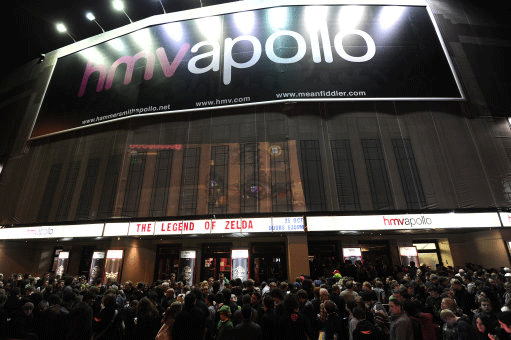
HMV's response? In 2009, it joined up with the MAMA Group to buy a 50% share in their business of owning iconic music venues. This brought the HMV brand to places such as The Hammersmith Apollo which became the HMV Apollo. Later that year, it bought the business outright, but running music venues in a crowded market place is a tough thing, it needs time and investment, and with the stresses and strains elsewhere in its business, HMV sold out just two years later to bring in some much-needed capital.

Books And Other Distractions


The final elements of HMV's portfolio, and an increasingly large distraction from selling music, was its ownership of the High Street book chain, Waterstones. It had over 250 stores around the UK and had been founded by book-seller extraordinaire, Tim Waterstone in 1982. It took a revolutionary approach to retailing and was bought out by W H Smith in 1993, Waterstone's former employer. By 1998, Tim Waterstone had decided to try and buy back his stores and launched a bid for the whole W H Smith empire. As a protective measure, W H Smith sold the Waterstones stores to HMV for £200m - and HMV brought its founder back to head the business.

Ottakers, a boutique-style rival chain of booksellers was added in 2006, but by then, on-line sales of books was having an impact on the abilty of the whole chain to compete. Whilst profitability was maintained to some extent, sales and market share were falling - and HMV, strapped for cash, sold the empire to A & NN Capital Fund Management in 2011 for barely a quarter of what they had paid for it 13 year earlier. The other threat to the business was the increasing acceptance by the public of e-books and book-readers such as the Kindle. HMV won't have to face that challenge, but I do hope that Waterstones manages to ride out that storm and survive.

High Street Woes?


So, we're back to HMV being put into administration on January 15th, 2013.

Some might think that no High Street store should be immune from the economic reality of life in 21st century Britain, change is for the good and maybe one day, we'll be anxious about the loss of iTunes or some such other on-line business. Others argue that for towns and cities to survive, a strong retail presence is vital - and speaking personally, the social cohesion of a town is down to retail, entertainment and employment attractions. If these disappear, what future is there for our towns and High Streets? Reinvention will happen, but I do trust that there will be a happy mix of real stores and virtual stores, I hope that the pleasures of shopping and browsing - the tactile experience of books and music in my case - will live on.

HMV itself may well survive in some form.

It's too early to say specifically what will happen, but already there are encouraging noises being made by the record and entertainment industry that its physical presence is a necessary element of the future. I suspect they fear being held in thrall solely to the on-line world and hope for a bit of competition. I hope too that there's a recognition that not everyone chooses (or is able) to buy on-line. A buyer for the group may have some advantages: if they have the funding to buy the brand and the stores, then they start afresh with no debt. Some stores will close, of that there is no doubt. They're in the wrong places now, they're the wrong size and they may well be locked into punitive leases. I fear for the staff numbers too. However, with some genuine focus and (that horrible word) re-purposing of their offering, HMV may yet survive.

We shall see.

Alan

15th January 2013